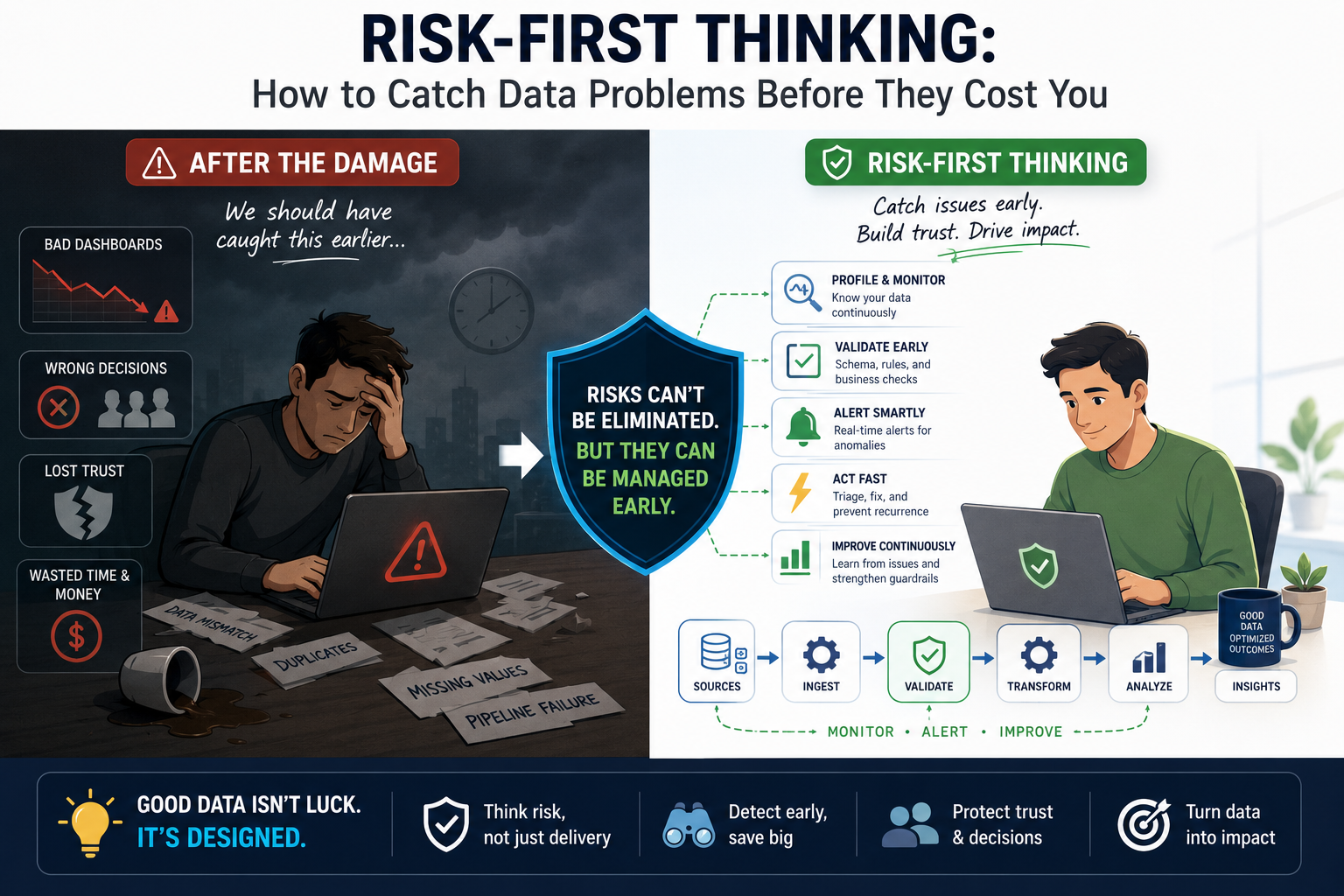
I've spent close to a decade in data. The most expensive mistakes I've seen didn't come from bad engineers — they came from engineers who never asked "what if this breaks?"
A few years into my career, I was working on a high-stress performance engineering project — the kind where a missed edge case costs real money and there's no room to shrug and say "we'll fix it in the next sprint." The margin for error was near zero.
That environment taught me something I carry into every project today: the best time to find a problem is before it becomes one.
I call this mindset risk-first thinking. It's not about being fearful or overly cautious. It's about asking the uncomfortable questions early — so your systems, your pipelines, and your clients don't pay for the answers later.
Where it starts: the QA mindset in an engineering world
I didn't begin my career as a data engineer. I came through software testing — working with teams whose average experience was decades deep, learning how to approach a problem with what I can only describe as constructive suspicion. Where does this break? Who else touches this? What happens at scale?
That background gave me something most engineers don't have: I've seen what happens when problems are caught late. Bug discovered in testing? Fixable. Bug discovered after a data pipeline has been corrupting a financial model for three months? That's a different conversation entirely.
The best engineers I know aren't the ones who write the most elegant code. They're the ones who ask the most uncomfortable questions.
When I moved into data engineering — building data lakes, orchestrating ETL jobs with Airflow, transforming data with Spark and Glue, handling ingestion via Kafka and Kinesis — I brought that testing psychology with me. It changed how I design systems.
What risk-first thinking actually looks like
Risk-first thinking is not a formal framework. It's a set of habits that become instinctive over time. Here's what it looks like in practice:
- Asking "what if" before writing a line of code. What if this upstream source schema changes? What if this job runs twice? What if the API returns a null field we're not handling? These questions feel slow at the start. They save days at the end.
- Designing for failure, not just for success. A pipeline that runs perfectly 99% of the time is a pipeline that fails silently 1% of the time. I build systems that expect failure — with retries, dead-letter queues, data quality checks, and alerts that fire before a data scientist notices something is off.
- Sensing when something doesn't add up. This one is harder to teach. After enough time in data, you develop a feel for when numbers are wrong — when a dashboard metric looks slightly too clean, or when a row count jumps in a way that can't be explained by organic growth. Trusting that instinct and investigating it is a skill in itself.
- Always having a backup plan. What happens if this job fails at 2am? Who gets notified? Is there a fallback? Can we reprocess? Risk-first engineers think about the operational reality of their systems, not just the happy path.
What this means for the teams I work with
When I work with a data team, I'm not just building pipelines. I'm asking questions that sometimes feel uncomfortable in the moment but matter enormously later:
Who owns data quality when something breaks at 3am? What's the blast radius if this table gets corrupted? Have we tested what happens when this external feed goes down? Are the data scientists making decisions on numbers we've actually validated?
I've worked closely with data analysts and data scientists throughout my career — my job was always to get them the right data, at the right time, with enough confidence that they could actually act on it. That's harder than it sounds. It requires caring about data quality not as a checkbox, but as the foundation that everything downstream depends on.
A data scientist making a decision on bad data isn't a data scientist problem. It's a data engineering problem that travelled upstream.
The question every data team should be asking
Before your next sprint planning, before your next pipeline goes to production, before you sign off on a data model — ask this:
If this breaks in the worst possible way, at the worst possible time, what happens?
If you have a clear answer — a runbook, an alert, a fallback, a tested recovery path — you're in good shape. If the answer is "I guess we'd figure it out," that's the gap worth closing.
Risk-first thinking isn't about slowing down. It's about building systems that don't slow you down later — when the cost of a problem is no longer a planning conversation, but a production incident.
Supreeth M Gowda has spent 12+ years across data engineering, software engineering, performance engineering, and data science. He now consults through Encore — learn more about him and his services.