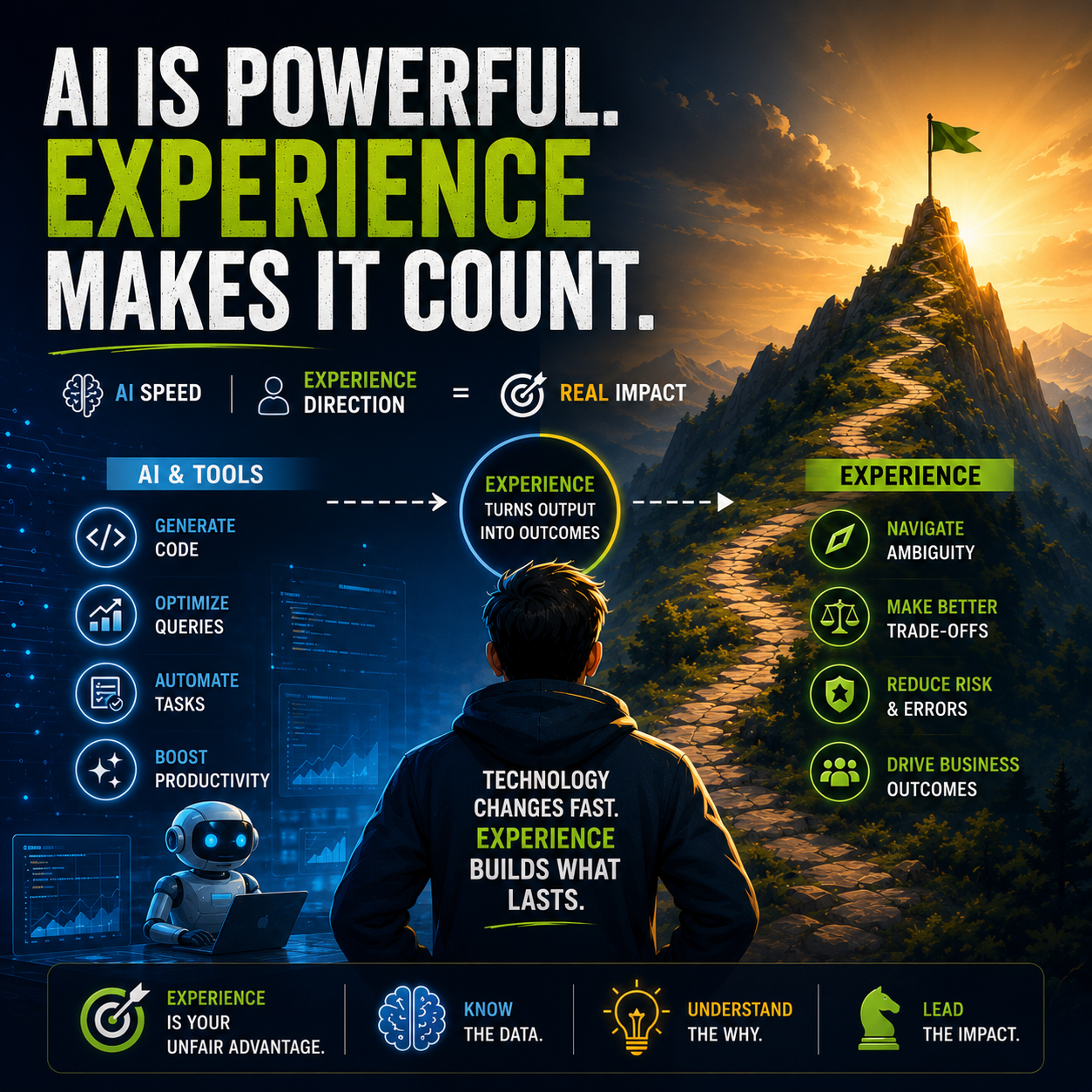
Coding was never the bottleneck.
Long before AI could write a single line, the hard part of software was never typing it out. It was picking the right tool, the right framework, the right design for the problem at hand. Implementation was the easy 20%. Judgment was the other 80% — and it still is.
What's changed isn't the nature of the bottleneck. It's who gets to skip past it.
The old gate
Before, if you wanted to build something non-trivial, you had to go through people who'd seen it fail before. You hired an architect, consulted a senior engineer, sat through a design review that slowed you down on purpose. That friction was annoying, but it was also a filter. Bad ideas got caught at the whiteboard stage, when fixing them cost an afternoon, not a quarter.
AI removes that filter. It doesn't remove the need for judgment — it just removes the moment where judgment used to get applied. Now anyone with an idea and a prompt can generate something that runs, ships, and looks done, without anyone in the loop asking should this exist the way it's built.
Speed didn't replace judgment. It just postponed the bill.
Same code, more of it
Here's the part that doesn't get talked about enough: AI hasn't just made bad architecture easier to ship — it's changed the economics of duplication.
Before, if you needed similar functionality in two places, the lazy path and the disciplined path were roughly the same effort. You'd extract a shared function, write an interface, follow something like SOLID's open/closed principle, because doing it "right" wasn't meaningfully slower than doing it twice.
Now it is. Generating a new, slightly-different version of existing logic takes one prompt. Going back into an existing module, understanding why it was built that way, and extending it safely takes real comprehension — comprehension the tool doesn't have and the person prompting it often doesn't either. So the path of least resistance flips: writing new code becomes cheaper than understanding old code. Codebases fill up with five near-identical implementations of the same idea, each one slightly diverged, none of them owned by anyone who can explain the differences.
That's not a style problem. That's the thing SOLID and DRY existed to prevent in the first place — and the incentive AI creates is pointed directly at violating them.
The bill comes due downstream
This is the part your background in QA and performance engineering probably already recognises: the cost of a bad decision doesn't disappear when you skip the review that would've caught it. It just moves downstream and compounds.
A framework chosen by someone who didn't understand the tradeoffs doesn't fail in week one. It fails eighteen months later, when the team is locked into something that can't scale, can't be migrated cleanly, and can't be explained by the person who picked it — because that person already moved to the next fast thing. By then it's not a design discussion anymore. It's a rescue operation.
We've seen this exact pattern before, just slower: teams adopting Iceberg or Delta Lake because everyone's adopting it, without budgeting for the operational complexity underneath. AI just collapses the timeline. What used to take a few bad quarterly decisions to compound into real debt now takes a few bad sprints.
What doesn't change
Understanding the application, the tools, and the domain was the bottleneck before AI, and it's still the bottleneck now. AI didn't close that gap — it widened who's allowed to operate without closing it.
That's why the next decade likely doesn't belong to whoever can generate the most code the fastest. It belongs to people who can look at a fast-shipped system and tell you why it's going to break, where the duplication is hiding, and what it would actually take to fix it without a rewrite. That's not a skill AI produces as a side effect of writing code. It's the skill that was always scarce, now applied to a much bigger pile of output.
If you're trying to figure out whether your own systems are heading toward that bill — faster shipping today, bigger rescue operation later — that's exactly the kind of assessment I help teams run.
Supreeth M Gowda has spent 12+ years across data engineering, software engineering, performance engineering, and data science. He now consults through Encore — learn more about him and his services.